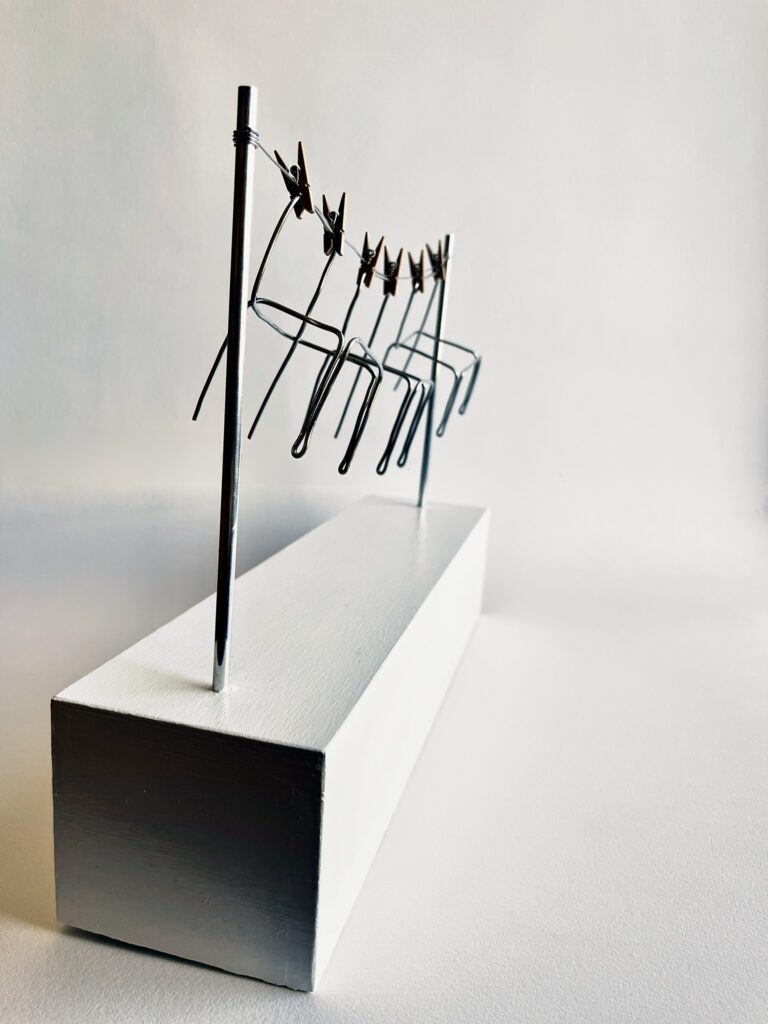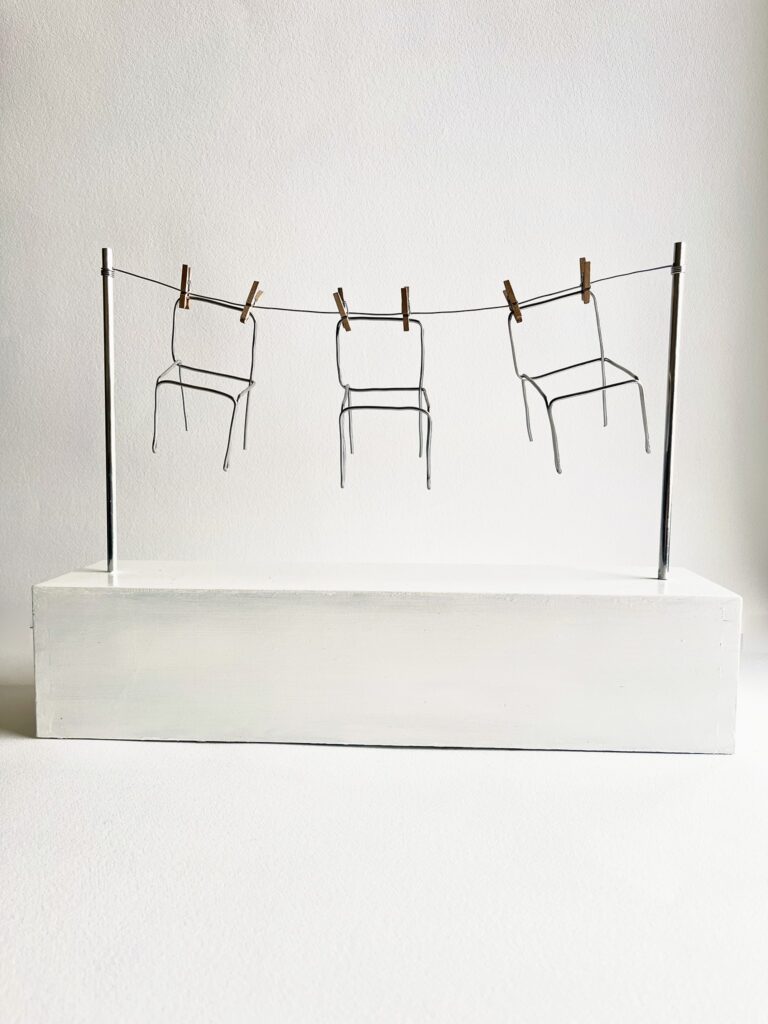
Chairs

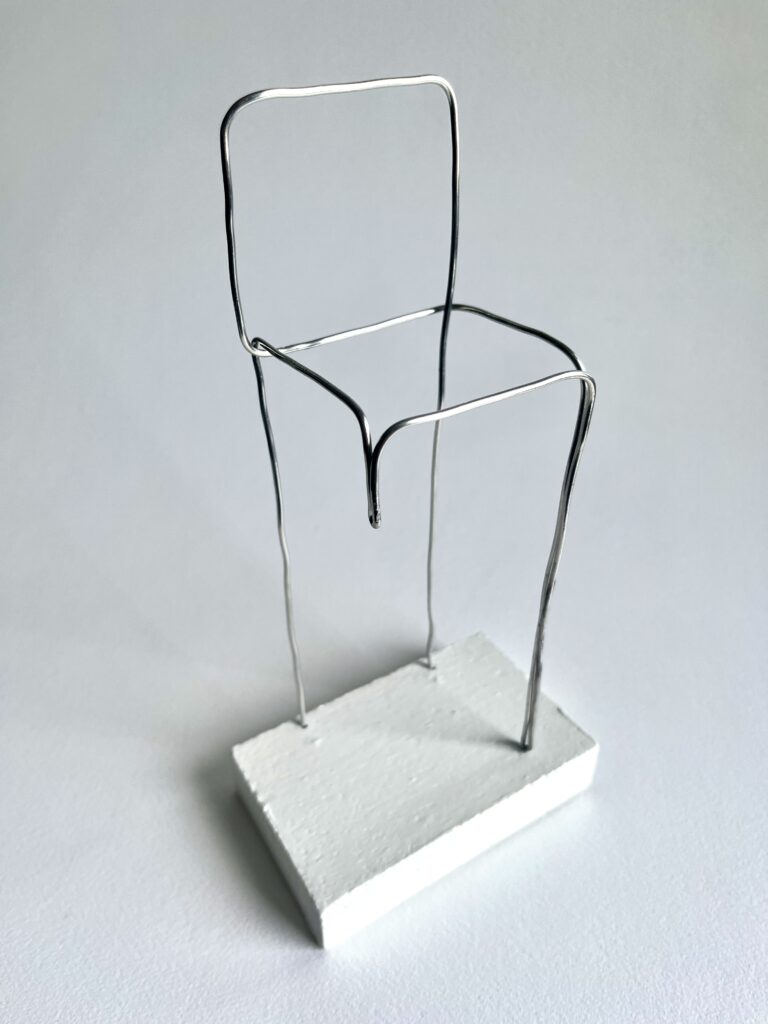
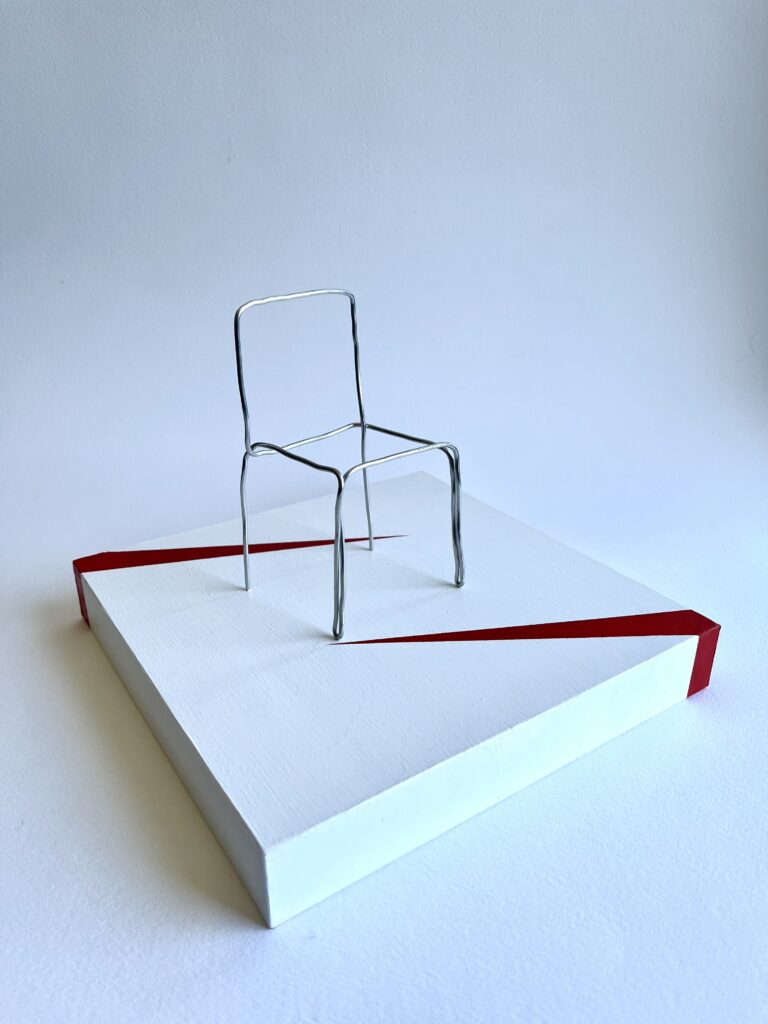
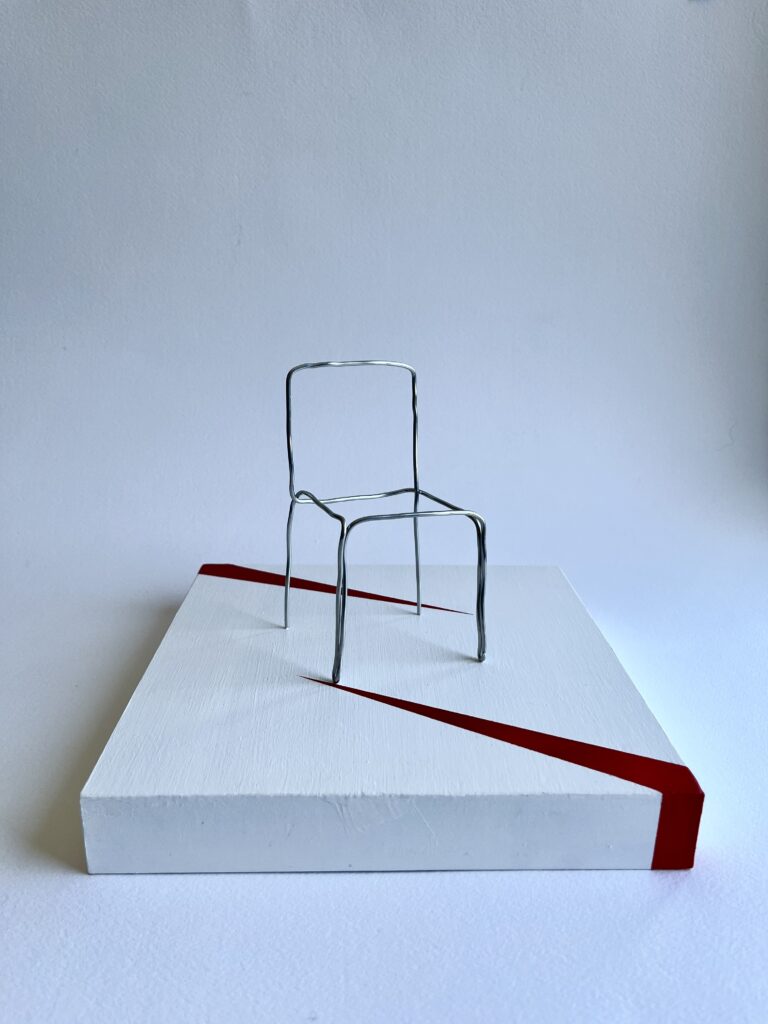
Small aluminium wire chair standing upright on a white panel, angled view
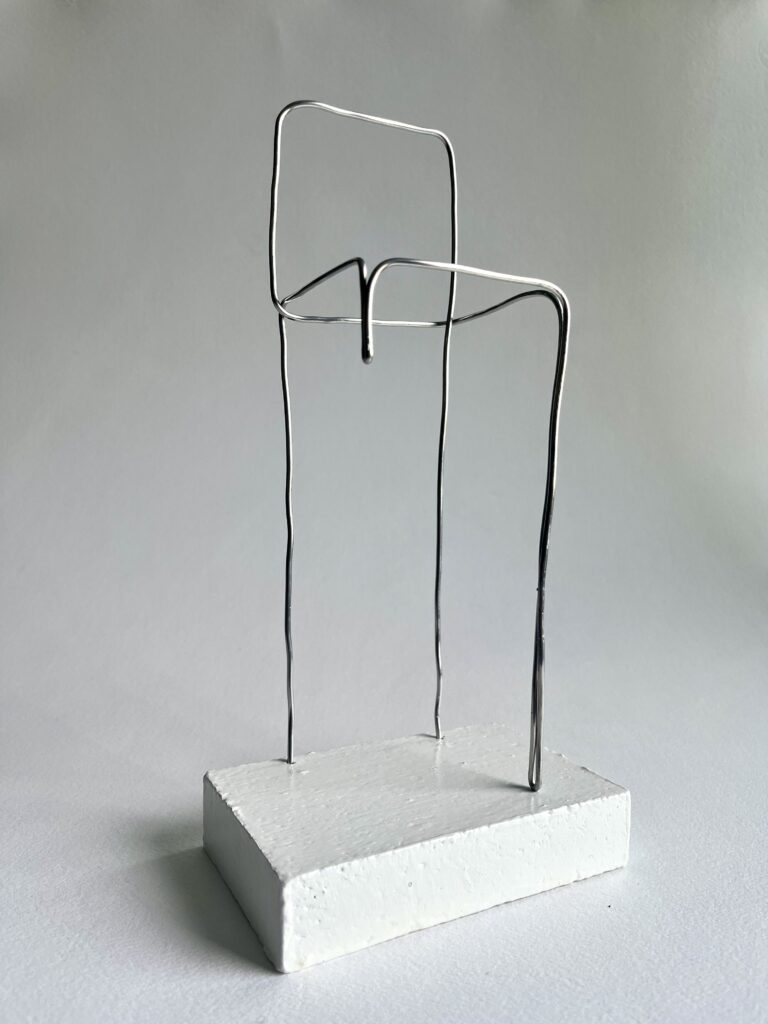
Small aluminium wire chair standing upright on a white panel, seen from the front

Chair, Unoccupied (Chaise, inoccupée), 2026


Aluminium wire and acrylic on wood panel
Chair: 11 × 6,5 × 5,5 cm
Panel: 20 × 20 × 3 cm

300 €

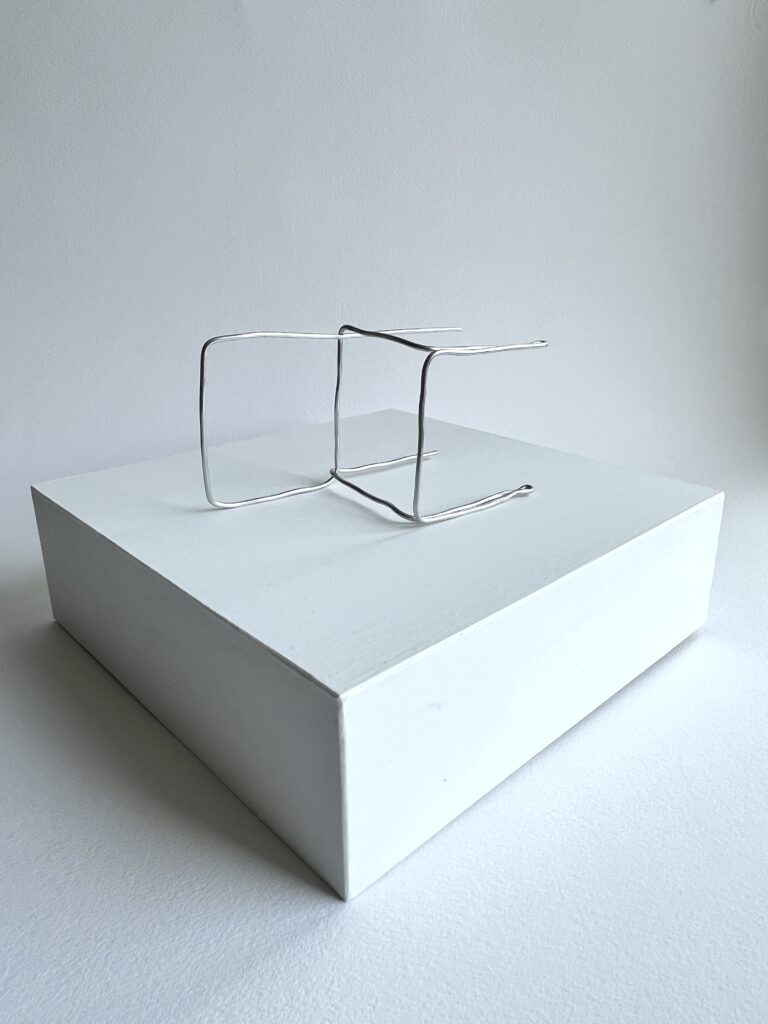
Small aluminium wire chair lying on its side on a white panel, angled view
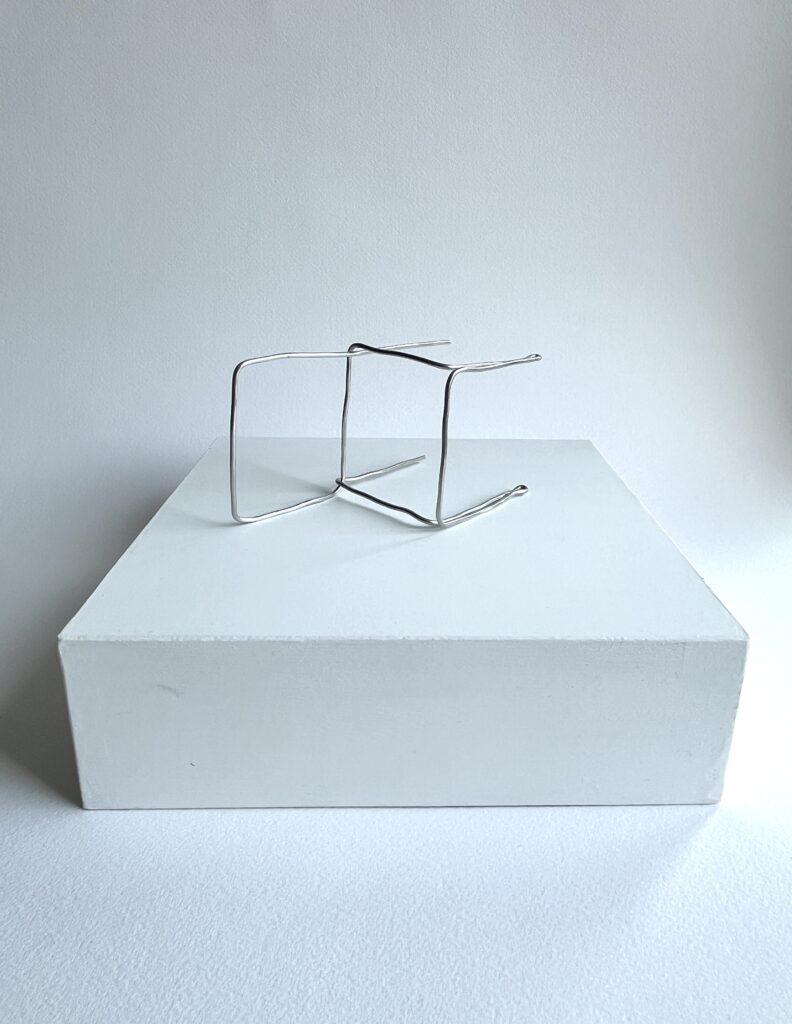
Small aluminium wire chair lying on its side on a white panel, seen from the front

Chair, Undone (Chaise, défaite), 2026


Aluminium wire and acrylic on wood panel
Chair: 6,5 × 11 × 5,5 cm
Panel: 20 × 20 × 6 cm

300 €

Small aluminium wire chair with one shortened leg on a white panel, seen from above
Small aluminium wire chair with one shortened leg on a white panel, seen from below

Chair, Ungrounded (Chaise, sans appui), 2026


Aluminium wire and acrylic on wood panel
Chair: 22 × 6 × 6 cm
Panel: 11,5 × 7 × 2 cm

300 €

DEPURPOSING

Depurposing began with an object, not a theory.

I had been making small chairs from a single length of aluminium wire. The first stood upright on a panel. I called it Chair, Unoccupied: a chair’s purpose is to be sat in, and this one was waiting. For the second, I used an identical chair and turned it onto its side. Nothing was cut, bent, or removed. I called it Chair, Undone.

The object remained unmistakably a chair. But it could no longer be encountered as one. Its purpose had not been replaced. It had simply stopped applying.

The linguist Samuel Jay Keyser proposed depurposed, in conversation about the work. English has no settled word for this condition. Defunct, obsolete, disused: something failed, or was superseded, or was abandoned. Nothing failed here. The chair was turned, and the absence of a word for that is part of what the work is about.

Definition

Depurposing is the deliberate removal, suspension, or obstruction of an object’s intended function, while retaining enough of its identity for the lost function to remain perceptible.

If the object is destroyed, or altered past recognition, nothing has been depurposed. What remains must still declare what it was for.

Distinct from repurposing

Repurposing replaces a purpose. A screwdriver becomes a doorstop; a church becomes a concert hall. The object continues to be useful, differently.

Depurposing removes purpose without supplying another. The object continues to exist, uselessly, and remains legible as the thing it can no longer be.

Distinct from the readymade

Duchamp’s operation is one of relocation. The urinal is unaltered; the gallery does the work. Function is suspended by context, and the object acquires a new status as art.

Depurposing operates on the object’s own condition rather than its setting. Chair, Undone would still be depurposed lying on its side in a kitchen. No new status is conferred. The suspension is in the object, not around it.

Related but not identical

Shklovsky’s ostranenie, his term for making strange, restores perception to what habit has made invisible. But it operates through description. Depurposing operates on the object.

For Heidegger, a tool in use withdraws from attention. Hammering, you attend to the nail, not the hammer; the tool is absorbed into the task. He calls this the ready-to-hand. When it breaks, goes missing, or gets in the way, it stops being equipment and becomes conspicuous, a thing with weight and shape that you now look at rather than through. He calls this the present-at-hand. The mechanism is close to what is described here. The difference is that Heidegger’s tool fails, and this one was turned on purpose.

Cornelia Parker’s Cold Dark Matter: An Exploded View and Gordon Matta-Clark’s Splitting depurpose through destruction. The operation proposed here does not require damage, and in its clearest form involves none.

What it produces

In use, a chair is invisible, absorbed into sitting, never looked at. Depurposed, it is nothing but a thing to look at. Function is a kind of blindness, and its removal is a way of seeing.

DÉFINALISATION

La définalisation a commencé par un objet, non par une théorie.

Je faisais de petites chaises à partir d’un seul fil d’aluminium. La première tenait debout sur un panneau. Je l’ai appelée Chair, Unoccupied: une chaise a pour fonction d’être occupée, et celle-ci attendait. Pour la seconde, j’ai pris une chaise identique et je l’ai couchée sur le côté. Rien n’a été coupé, plié ni retiré. Je l’ai appelée Chair, Undone.

L’objet restait indubitablement une chaise. Mais on ne pouvait plus le rencontrer comme tel. Sa fonction n’avait pas été remplacée. Elle avait simplement cessé de s’appliquer.

C’est le linguiste Samuel Jay Keyser qui a proposé depurposed, au cours d’une conversation sur ce travail. L’anglais n’a pas de mot établi pour cette condition. Defunct, obsolete, disused: quelque chose a échoué, a été remplacé, a été abandonné. Ici rien n’a échoué. Le français dispose de désaffecté, mais c’est un mot pour les bâtiments, et il suppose une décision prise par quelqu’un. Personne n’a rien décidé. La chaise a été tournée, et l’absence d’un mot pour cela fait partie de ce dont l’œuvre traite.

Définition

La définalisation est la suppression, la suspension ou l’obstruction délibérée de la fonction d’un objet, tout en conservant assez de son identité pour que la fonction perdue demeure perceptible.

Si l’objet est détruit, ou altéré au point d’être méconnaissable, rien n’a été définalisé. Ce qui reste doit encore déclarer ce à quoi il servait.

Distincte du détournement

Le détournement remplace une fonction par une autre. Un tournevis devient une cale de porte; une église devient une salle de concert. L’objet continue de servir, autrement.

La définalisation retire la fonction sans en fournir d’autre. L’objet continue d’exister, inutilement, et reste lisible comme la chose qu’il ne peut plus être.

Distincte du ready-made

L’opération de Duchamp est un déplacement. L’urinoir est intact; c’est la galerie qui fait le travail. La fonction est suspendue par le contexte, et l’objet acquiert un nouveau statut, celui d’œuvre d’art.

La définalisation opère sur la condition de l’objet même, non sur son cadre. Chair, Undone serait tout aussi définalisée couchée sur le côté dans une cuisine. Aucun statut nouveau n’est conféré. La suspension est dans l’objet, non autour de lui.

Proche mais distincte

L’ostranenie de Chklovski, terme qu’on rend par étrangéisation, rend à la perception ce que l’habitude a rendu invisible. Mais elle opère par la description. La définalisation opère sur l’objet.

Pour Heidegger, l’outil en usage se retire de l’attention. Quand on cloue, on regarde le clou, non le marteau; l’outil est absorbé dans la tâche. Il appelle cela l’être-à-portée-de-la-main. Quand l’outil se casse, manque, ou fait obstacle, il cesse d’être un ustensile et devient manifeste, une chose avec un poids et une forme, qu’on regarde désormais au lieu de regarder à travers. Il appelle cela l’être-sous-la-main. Le mécanisme est proche de ce qui est décrit ici. La différence est que l’outil de Heidegger échoue, tandis que celle-ci a été tournée volontairement.

Cold Dark Matter: An Exploded View de Cornelia Parker et Splitting de Gordon Matta-Clark définalisent par la destruction. L’opération proposée ici n’exige aucun dommage, et sous sa forme la plus claire n’en comporte aucun.

Ce qu’elle produit

En usage, une chaise est invisible, absorbée dans le fait de s’asseoir, jamais regardée. Définalisée, elle n’est plus qu’une chose à regarder. La fonction est une forme d’aveuglement, et la lever est une façon de voir.

Return to artworks